

Why Does a Breaker Trip When It Rains? Finding the Wet Spot
Why does a breaker trip when it rains? Water is getting into something electrical and leaking current to ground. A GFCI breaker or outlet senses that leak and cuts power, often within a fraction of a second. The usual spots are outdoor outlets, exterior lights, landscape wiring, buried cable and a leaking meter base or panel. The trip is a safety feature working, but the wet spot still needs finding.
Key Takeaways
- Rain trips are usually ground faults, not overloads.
- GFCI protection trips on leaks as small as about 5 milliamps.
- Outdoor outlets with worn covers are the top cause.
- Exterior lights, holiday lights and buried wire come next.
- Water in the panel or meter base is serious. Call quickly.
- Never bypass a GFCI to stop the trips.
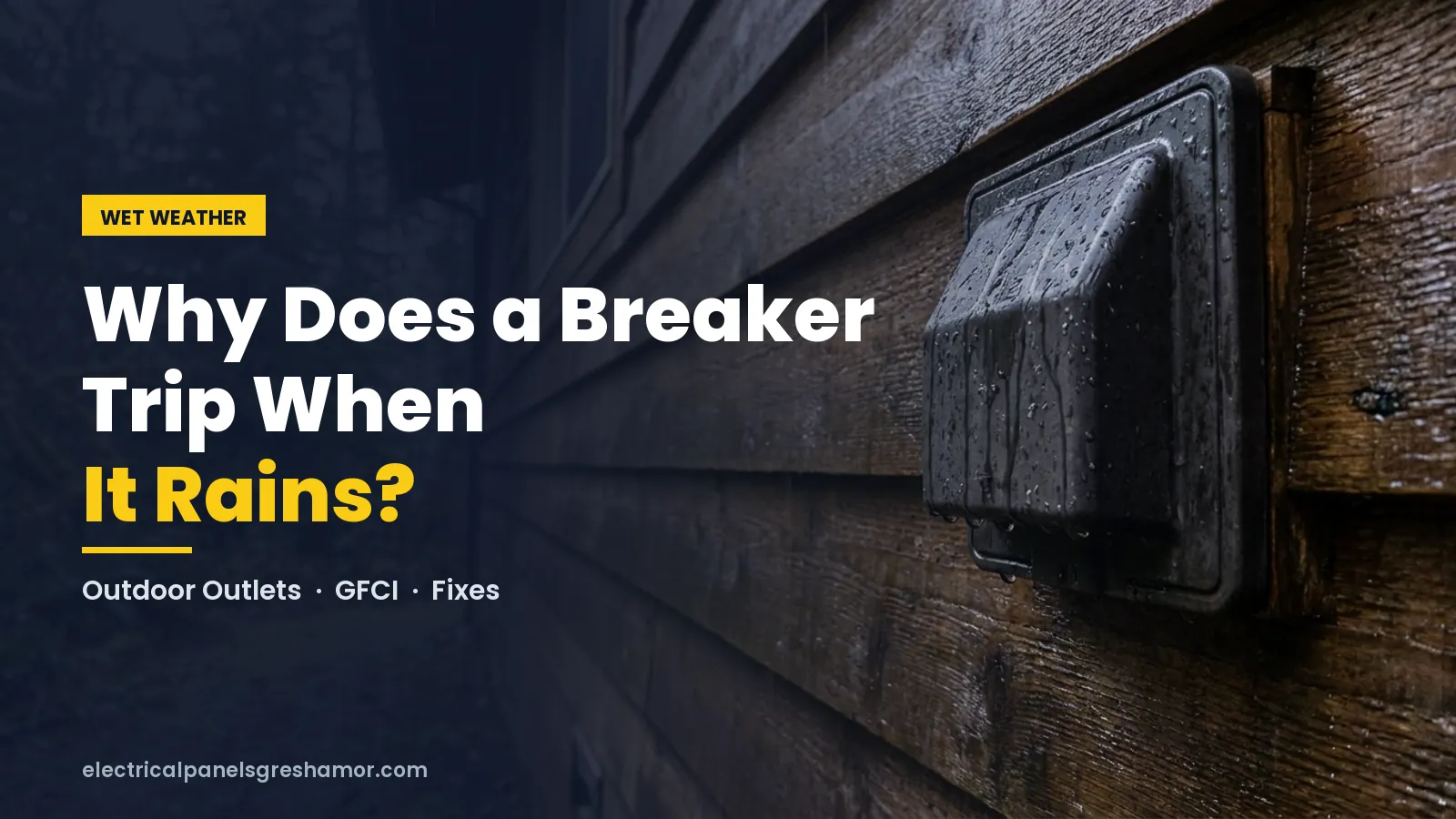
It rains, and the lights in the garage go out. The patio outlet is dead. Two days later, when things dry out, everything works again. In the Gresham area, where the wet season runs from October to May, this pattern is familiar.
The breaker is not being fussy. Water conducts electricity. When it reaches a live part, some current slips away to ground instead of returning on the neutral. That missing current is exactly what GFCI protection watches for.
Why Does Rain Make a Breaker Trip?
Rainwater creates a path from a hot wire to ground. Current leaks out, the GFCI sees the imbalance and trips.
A GFCI compares the current going out on the hot wire with the current coming back on the neutral. They should match. If a few milliamps go missing, they are flowing somewhere else, possibly through a person. The device trips to stop that.
Regular breakers rarely trip from rain alone. A small leak is far below their 15 or 20 amp rating. So a rain trip almost always means GFCI protection is involved, either a GFCI breaker in the panel or a GFCI outlet upstream. A heavy flood that causes a real short can trip a standard breaker, but that is less common.
Where Does the Water Usually Get In?
| Location | What goes wrong |
|---|---|
| Outdoor outlets | Cracked or flat covers, missing gaskets, cords left plugged in |
| Exterior light fixtures | Failed seals, water pooling in the box |
| Holiday and string lights | Cheap plugs and splices sitting in puddles |
| Buried cable | Nicked jacket, wrong cable type, wet conduit |
| Hot tub or pump circuits | Wet disconnects and motor seals |
| Meter base or panel | Water entering along the service mast or conduit |
Outdoor outlets top the list. Older flat covers only seal when nothing is plugged in. The NEC now requires in use covers, often called bubble covers, for wet locations under 406.9(B). Many older Gresham homes still have the flat style.
Garages count too. A garage outlet near a leaky door can get wet. So can a basement outlet near a window well. If a detached garage or shop has its own subpanel, its feeder may run underground. See do you need a ground rod for a detached garage.
Is the GFCI Overreacting?
Rarely. A GFCI that trips only in wet weather is usually reporting a real leak. It is doing exactly what it is designed for.
Old GFCIs can become oversensitive or fail entirely. The test button checks the trip mechanism. If it trips in dry weather with nothing connected, the device may be worn. But if the trips line up with rain, the leak is real and the GFCI is fine. Replacing it with a non GFCI device just removes the warning while leaving the shock hazard.
How Do You Find the Wet Spot?
Unplug Outside
Remove every cord, light and tool from outdoor outlets.
Reset and Wait
Reset the GFCI. If it holds through rain, a plugged in item was the cause.
Inspect Covers
Look for cracked covers, missing gaskets and water in boxes.
Still Tripping?
The fault is in fixed wiring. An electrician can test with a megger.
Do this in dry daylight if you can. Do not open wet boxes while energized. If the trips continue with nothing connected, the wire itself or a fixture is likely wet. An electrician can isolate each run and measure insulation resistance to find the bad section.
If the breaker trips instantly even in dry weather, the problem may be different. See why a breaker will not stay on.
How Do You Stop Rain From Tripping the Breaker?
- Install in use bubble covers on every outdoor outlet
- Replace worn outdoor outlets with weather resistant WR rated GFCIs
- Reseal or replace leaking exterior light fixtures
- Use outdoor rated cords and keep connections off the ground
- Have damaged or wrong type buried cable replaced
- Seal conduit entries and drill weep holes where allowed
These are small, affordable fixes. A new in use cover and WR GFCI often cost less than a single service call for repeated trips. For outdoor equipment like a hot tub, the setup matters more. See does a hot tub need its own subpanel.
What If Water Is Getting Into the Panel?
Treat it as urgent. Water in a panel or meter base can corrode connections, cause arcing and lead to fire or shock.
- Rust streaks or water stains inside the panel door
- Drips from the service mast or meter base
- Several breakers tripping at once in storms
- Buzzing or crackling from the panel when it rains
Water often follows the service entrance cable or conduit. A failed weatherhead or meter seal lets it run straight into the panel. Do not touch a wet panel. Call an electrician, and possibly the utility if the meter base is involved. Buzzing is a red flag. See why an electrical panel buzzes.
What Does It Cost to Fix a Rain Trip?
| Fix | Rough range |
|---|---|
| In use outlet cover | $15 to $40 part |
| Replace outdoor GFCI outlet | $150 to $300 installed |
| Reseal or replace exterior light | $150 to $400 |
| Repair buried cable | $400 to $1,500+ |
Planning ranges, not quotes. Buried cable costs depend on length and digging access.
FAQ
Why does my GFCI trip only when it rains?
Water is reaching a connection on that circuit and leaking current to ground. Check outdoor outlets, lights and anything plugged in outside.
Can a wet outlet dry out and be fine?
Sometimes, but corrosion often follows. Repeated wetting damages the device. Replace it and fix the cover.
Is it safe to keep resetting it?
Reset once to test. If it keeps tripping in rain, find the leak. Do not use the outlet outside until fixed.
Can rain trip a regular breaker?
Only with a large fault, such as water causing a direct short. Most rain trips are GFCI trips.
Do outdoor outlets need GFCI protection?
Yes. NEC 210.8 requires GFCI protection for outdoor outlets at homes.