

Do I Need a Ground Rod for a Detached Garage? The One Circuit Rule Explained
Do I need a ground rod for a detached garage? You do if the garage has a subpanel or more than one circuit running to it. If the garage gets a single branch circuit, the NEC does not require a ground rod. Either way, the garage still needs an equipment ground wire back to the house. The rod is extra protection, never the main safety path.
Key Takeaways
- Subpanel in a detached garage: ground rod or other electrode required.
- One circuit to the garage, no panel: no rod required.
- Two rods at least 6 feet apart is the usual install.
- The rod wire lands on the garage panel's ground bar.
- Every circuit still needs a ground wire from the house.
- Rods and wire are cheap. Most of the cost is the feeder trench.
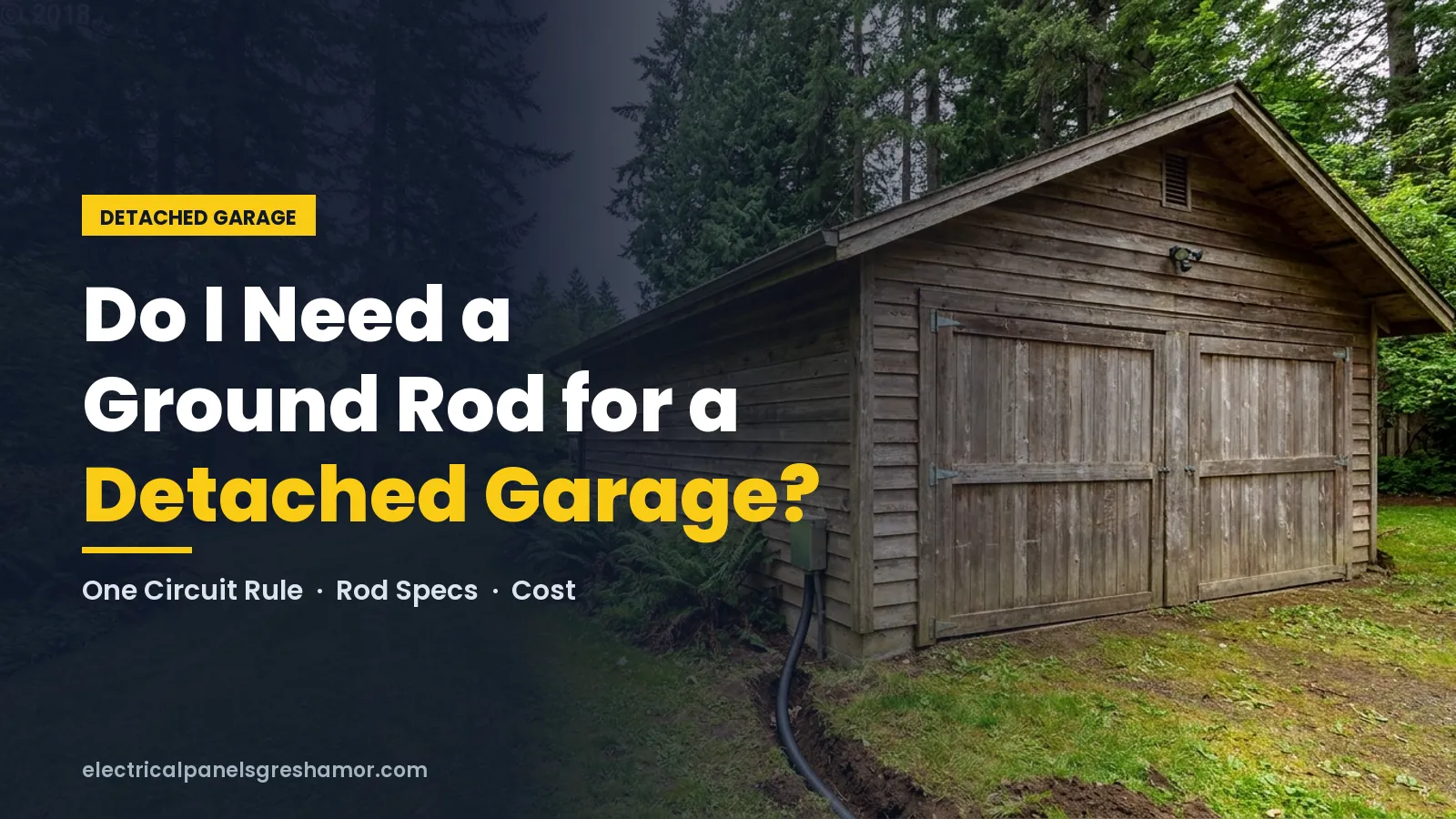
Detached garages are everywhere in Gresham. Older homes near downtown and Rockwood often have one at the back of the lot. Many were wired decades ago with a single extension style run. Now owners want lights, a workbench, maybe an EV charger.
That is when the ground rod question comes up. The rule is short, but it hinges on how many circuits you run. Decide that first. The grounding follows from it.
What Is the Ground Rod Rule for Detached Garages?
NEC 250.32(A) requires a grounding electrode at a separate building supplied by a feeder or more than one branch circuit. A single branch circuit is exempt.
A detached garage counts as a separate building or structure. A breezeway roof alone does not make it attached. If the garage shares no wall with the house, treat it as detached. Your inspector makes the final call.
| Garage power setup | Ground rod required? |
|---|---|
| One 15 or 20 amp circuit | No |
| One multiwire circuit (two hots share a neutral) | No |
| Two separate circuits | Yes |
| Any subpanel | Yes |
| Single 240V EV charger circuit, no panel | No |
Do I Need a Ground Rod If My Garage Has Only One Circuit?
No. A garage fed by one branch circuit needs no grounding electrode. The circuit's equipment ground wire provides the safety ground.
One 20 amp circuit covers more than people expect. Several LED fixtures. A few receptacles. A garage door opener. A small battery charger. If that is all you need, keep it simple.
That single circuit must still follow the rules for a detached building. It needs a disconnect at the garage, which can be a listed switch. Garage receptacles need GFCI protection. Underground wiring needs the right cable and depth, covered in do I need conduit for a subpanel.
Do I Need a Ground Rod If the Garage Has a Subpanel?
Yes. A subpanel means a feeder, and a feeder to a separate building requires a grounding electrode at that building.
The rod connects to the subpanel's ground bar. The neutral bar stays isolated. The bonding screw stays out. And the feeder brings four wires: two hots, a neutral and an equipment ground. We explain each piece in does a sub panel require 4 wires and does a sub panel need a bonding screw.
How Is a Ground Rod Installed at a Detached Garage?
Call 811 First
Oregon law requires a utility locate before you dig or drive. It is free.
Drive Two Rods
8 foot rods, at least 6 feet apart, near the panel. Top flush with or below grade.
Run the Wire
Continuous 6 AWG copper from rod to rod to the panel's ground bar. No splices unless listed.
Clamp and Inspect
Listed direct burial clamps. Leave the clamps visible for the inspector.
Rocky ground is the usual headache. If a rod hits rock, the code allows driving it at up to 45 degrees. If that fails, it can be laid in a trench at least 30 inches deep. Never cut a rod short and call it done.
How Much Does Grounding a Detached Garage Cost?
The rods and wire are a small part of the job. The feeder trench, panel and permit drive the total.
| Item | Rough range |
|---|---|
| Two ground rods, clamps, wire | $60 to $150 in parts |
| Labor to drive and connect | $150 to $400 |
| Garage subpanel installed | $800 to $2,000 |
| Underground feeder, per foot | $15 to $40 depending on trench and wire |
These are rough planning numbers, not quotes. Gravel driveways, concrete to cut and long runs all push costs up. If the house panel is maxed out, the bigger job may be the electrical panel upgrade that has to happen first.
What If My Old Detached Garage Was Wired Without a Ground?
Old 3 wire garage feeds bonded at the garage may be allowed to stay if unchanged. Any new feeder or major rework must use 4 wires and a rod.
Many older garages in the area were fed with two hots and a neutral, with the neutral bonded at the garage and tied to a rod. That was legal before 2008 if there was no other metal path between the buildings. It is not legal for new work. Some are even worse, with no ground at all.
- Two prong outlets in the garage
- Extension cord style wiring buried in the yard
- Tingle when touching a metal tool and the door
- Breakers in the garage that never trip
Any of those means call an electrician. Ungrounded garages with damp concrete floors are a real shock risk, and Oregon winters keep them damp.
What Should You Do Before Wiring a Detached Garage?
Decide on loads first, then the feeder size, then the grounding. Grounding is the last decision, not the first.
Make a list of what the garage will power in the next ten years, not just this year. Lights, outlets, door opener, freezer, compressor, heater, EV charger. Put a rough wattage next to each. If the total stays under about 1,900 watts and nothing needs 240 volts, one circuit works and no rod is needed.
If the list is bigger, plan a subpanel. Choose the feeder size, the trench route and the conduit size together. Then add the two ground rods to the plan. They go in near where the feeder enters the garage, with the ground wire running straight to the panel's ground bar.
Finally, check the house. Does the main panel have a free 2 pole space? Does a load calculation leave room for a 60 or 100 amp feeder? If not, the garage project starts at the house.
FAQ
Does a detached garage subpanel need its own ground rod?
Yes. Any subpanel in a separate building needs a grounding electrode at that building, typically two ground rods.
Can I bond the neutral and ground in a detached garage?
Not on a new 4 wire feeder. The neutral stays isolated and the rod lands on the ground bar.
Does an EV charger in a detached garage need a ground rod?
Not if it is on its own single circuit with no subpanel. It still needs an equipment ground wire.
Is one ground rod enough?
Only if it tests at 25 ohms or less. Most installers drive a second rod instead of testing.
Do I need a permit for this work in Gresham?
Yes. Feeders, subpanels and grounding electrodes need an electrical permit and inspection.