

Does a Sub Panel Require 4 Wires? Hots, Neutral and Ground Explained
Does a sub panel require 4 wires? In almost every home, yes. A 120/240 volt sub panel needs two hot wires, a neutral and a separate equipment ground. The only time 3 conductors work is when the panel feeds 240 volt loads only, with no neutral, or when metal conduit legally serves as the ground. The old 3 wire feed with no separate ground is not allowed for new work.
Key Takeaways
- Standard sub panel feeder: 2 hots + neutral + ground = 4 wires.
- Neutral carries normal return current. Ground carries fault current only.
- Combining them on one wire puts current on metal parts.
- 240V only panels with no neutral can use 2 hots + ground.
- Rigid or EMT conduit can serve as the ground path in some installs.
- Detached buildings lost the 3 wire option in the 2008 NEC.
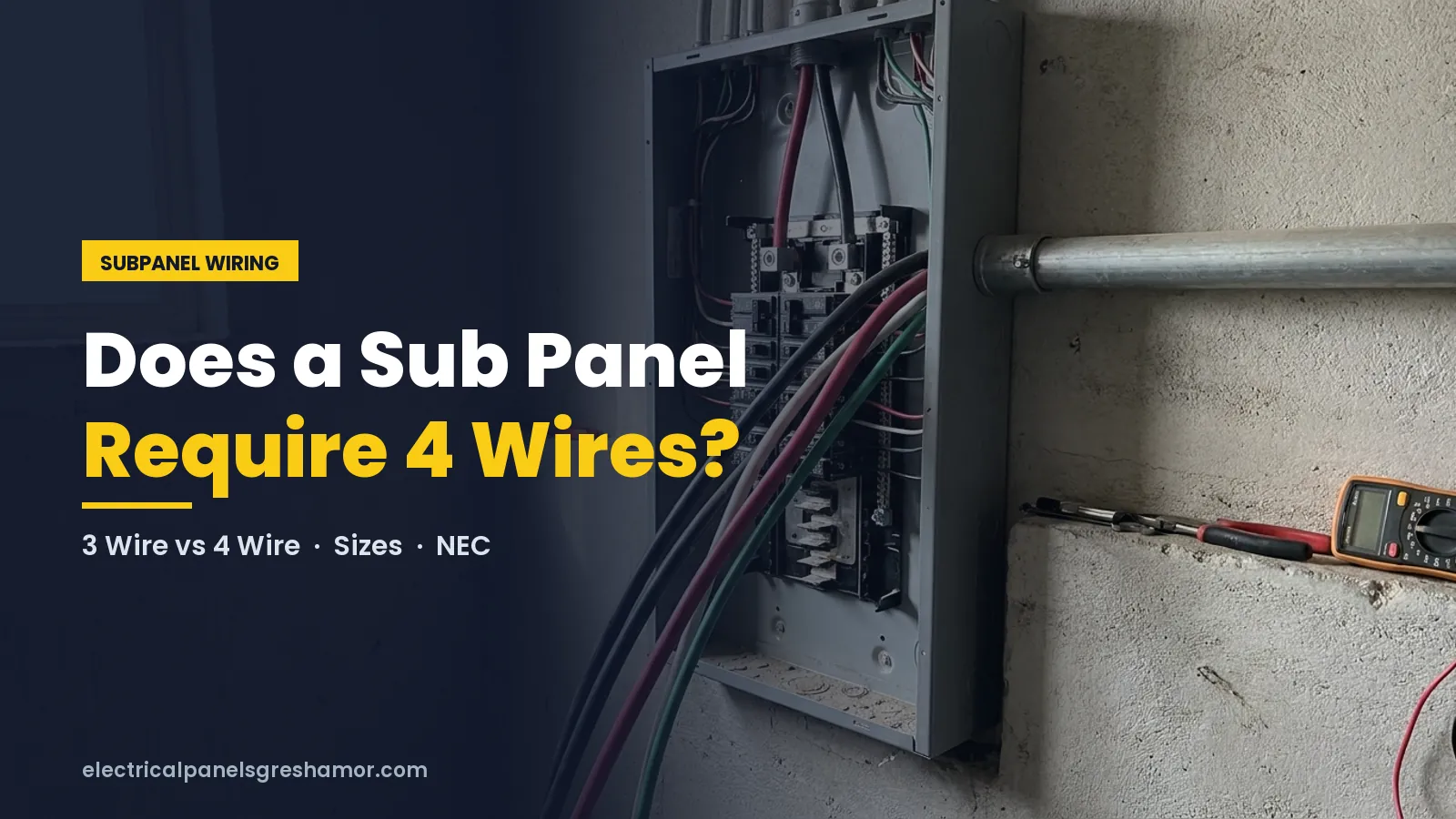
Walk into the electrical aisle at a Gresham hardware store and you will see two kinds of feeder cable. One says 6/3 with ground. The other says 6/2 with ground. The 3 or 2 counts the insulated wires. The ground is extra. That label is the whole question in a nutshell.
For a sub panel, you almost always want the "/3 with ground" version or four separate wires in conduit. Here is why, and when the exceptions apply.
Does a Sub Panel Need 4 Wires or 3?
A sub panel serving 120 volt and 240 volt circuits needs 4 conductors: two hots, one neutral and one equipment grounding conductor.
Most homes have a mix of loads. Lights and outlets run on 120 volts. Dryers, EV chargers and heaters run on 240 volts. A panel that serves both needs a neutral for the 120 volt side and a ground for safety. That is four.
| Wire | Job |
|---|---|
| Hot L1 (black) | Carries current, 120V to neutral |
| Hot L2 (red) | Carries current, 240V to L1 |
| Neutral (white) | Returns unbalanced current from 120V loads |
| Ground (green or bare) | Carries fault current only, trips the breaker |
Why Are Neutral and Ground Separate Wires?
The neutral carries current every time a 120 volt load runs. The ground should carry nothing until something fails. Keeping them apart keeps current off metal parts.
In a 3 wire setup, the neutral is bonded to the sub panel case. Every metal box and appliance frame connects to it. Normal return current flows on that same path. If the neutral wire loosens or breaks, nothing stops the voltage from showing up on every grounded surface.
With four wires, a broken neutral turns off 120 volt loads, but the ground wire still holds metal at earth potential. That is the safety margin the code wants. It is also why the sub panel's bonding screw must come out, as covered in does a sub panel need a bonding screw.
When Can a Sub Panel Use Only 3 Wires?
Three conductors work in two cases: a 240V only panel with no neutral loads, or an install where approved metal conduit is the equipment ground.
240V Only Loads
A panel for a well pump or a heat pump with no 120V circuits. Two hots and a ground. No neutral needed.
Metal Conduit as Ground
Rigid metal conduit or EMT can be the ground path under NEC 250.118. Three insulated wires inside.
Grandfathered Garage Feeds
Pre 2008 detached feeds with a bonded neutral may stay if untouched. No new installs.
A 240V only panel is rare in houses. Most owners want at least one 120V outlet or light later. Plan for four wires and you never have to re-pull the feeder.
What Cable or Wire Should a Sub Panel Feeder Use?
| Feeder type | Where it is used |
|---|---|
| NM cable, 6/3 or 4/3 with ground | Dry indoor runs, basements, attached garages |
| SER cable, 4 conductor | Larger feeders, 60 to 100 amps indoors |
| THHN or THWN in conduit | Exposed, wet or outdoor runs |
| XHHW or URD aluminum in conduit | Long underground runs to detached buildings |
| UF cable | Smaller direct burial feeders |
NM cable cannot go underground or in wet locations. Our guide on conduit for a subpanel covers when you need conduit and how deep to bury it.
Watch SE cable labeling. Older 3 conductor SE "style U" cable has a bare neutral. It cannot feed a sub panel in new work. You need 4 conductor SER.
What Should I Do If My Sub Panel Has a 3 Wire Feed?
If it is inside the same building, it likely needs to be corrected. If it feeds an old detached garage, it may be grandfathered, but any change triggers an upgrade.
- Neutrals and grounds share one bar in the sub panel
- The green bonding screw is installed
- Only three wires enter the panel and no metal conduit
- GFCI breakers trip for no clear reason
Any of these is worth a look by a licensed electrician. A fix usually means a new feeder. Sometimes it pairs with a panel upgrade in Gresham if the main panel is also undersized. If you are adding another panel down the line, see feeding a sub panel from another sub panel.
What Size Are the 4 Wires for Common Sub Panels?
The hots and neutral are sized to the feeder breaker. The ground is sized from NEC Table 250.122 and is usually smaller.
| Feeder breaker | Copper hots and neutral / copper ground |
|---|---|
| 30A | 10 AWG / 10 AWG |
| 40A | 8 AWG / 10 AWG |
| 60A | 6 AWG / 10 AWG |
| 100A | 3 AWG / 8 AWG |
These assume THHN or THWN-2 copper in conduit at 75 degree terminals. NM cable is limited to 60 degree ampacity, so it often needs one size larger. Long runs may need bigger wire for voltage drop. Aluminum needs larger sizes across the board.
The neutral can sometimes be smaller than the hots if the panel's 120 volt load is light, but most residential feeders keep it full size. It is simpler, and it covers loads that may be added later.
FAQ
Does a subpanel need a four wire connection?
Yes, if it serves 120V circuits. Two hots, a neutral and a separate ground.
Can I use 6/2 cable to feed a subpanel?
Only for a 240V only panel with no neutral loads. For a normal panel use 6/3 with ground.
Can the ground wire be smaller than the hots?
Yes. NEC Table 250.122 sizes it by the feeder breaker. A 60 amp feeder needs a 10 AWG copper ground.
Does a subpanel need a neutral wire?
Yes, if any circuit in it serves 120V loads. Nearly all residential subpanels do.
Can aluminum wire feed a subpanel?
Yes. Aluminum feeders are common and safe when sized up and landed on lugs rated for aluminum.