

Can You Feed a Sub Panel From Another Sub Panel? Rules, Sizing and Wiring
Can you feed a sub panel from another sub panel? Yes. The NEC allows it, and electricians do it all the time. The second panel gets its own breaker in the first panel, its own 4 wire feeder and its own isolated neutral bar. The catch is load. Every panel downstream still draws through the same main breaker, so the math has to work from the top.
Key Takeaways
- Feeding a sub panel from a sub panel is legal. It is often called daisy chaining.
- The second panel needs a dedicated feeder breaker in the first sub panel.
- Run 4 wires: two hots, a neutral and an equipment ground.
- Neutral and ground stay separated in both sub panels. Only the main panel is bonded.
- The first sub panel's feeder must carry the load of both panels.
- It needs a permit. In Gresham, plan on an inspection.
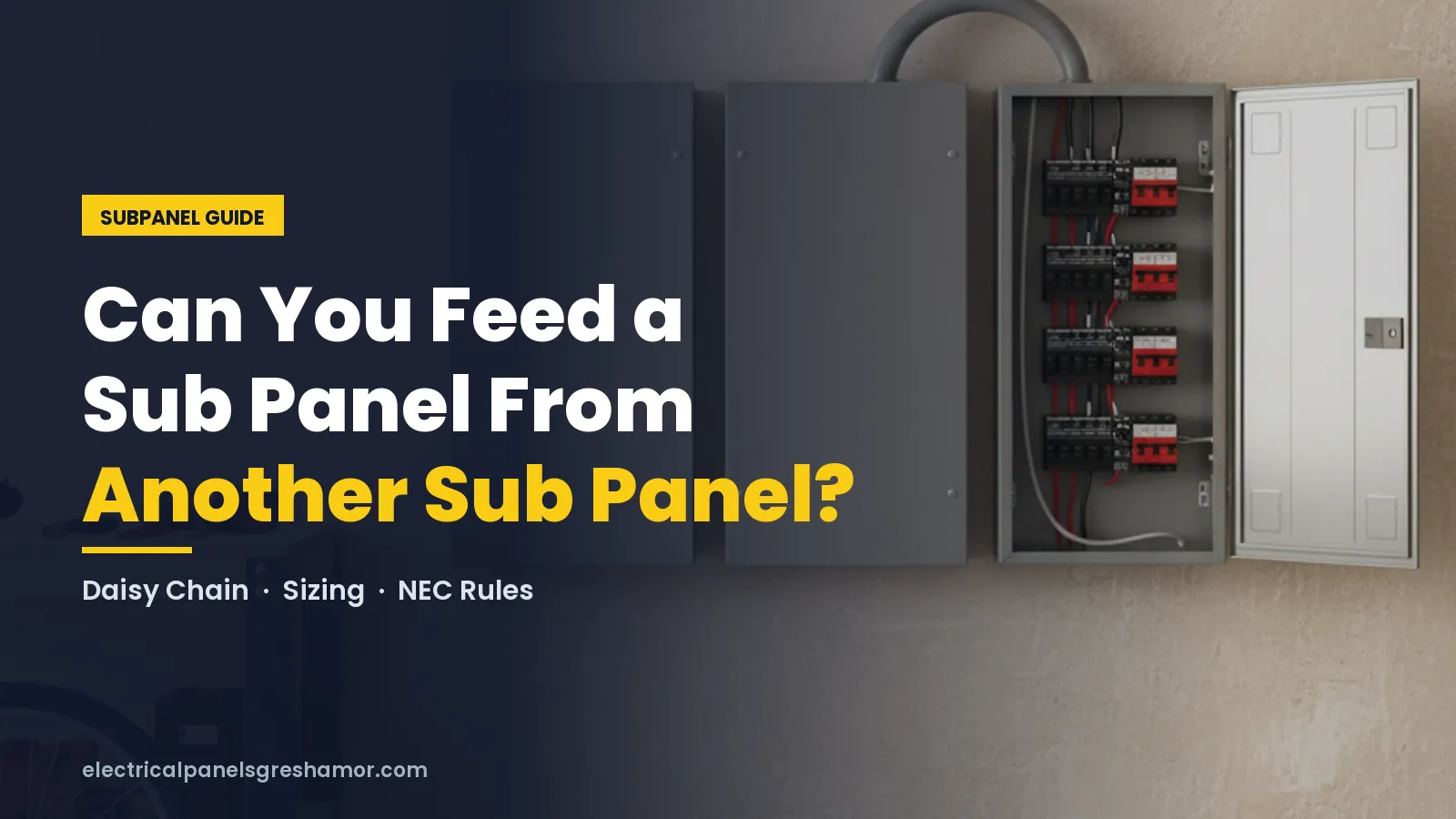
You added a subpanel to the garage a few years ago. Now you want power in the shop out back. The main panel is full. The garage subpanel has spare spaces. So the question is simple. Can the garage panel feed the new one?
It can. Nothing in the National Electrical Code limits how many panels sit in a chain. What the code cares about is protection, grounding and load. Get those three right and a sub fed from a sub is as safe as a sub fed from the main.
Is It Legal to Feed a Sub Panel From Another Sub Panel?
Yes. The NEC treats a sub panel fed from a sub panel the same as any other feeder. It needs overcurrent protection, a correctly sized feeder and proper grounding.
A subpanel is just a panelboard fed by a feeder. The code does not care where that feeder starts. It can start at the service panel. It can start at another subpanel. What matters is that the feeder has a breaker sized to protect its wires.
Your local inspector will check the same items either way. Breaker size. Wire size. Neutral and ground separation. Working clearance in front of the panel. The panel's own rating.
How Does a Daisy Chained Sub Panel Work?
Power flows from the main breaker, to a feeder breaker, to sub panel one, then through a second feeder breaker to sub panel two.
Think of it like water pipes. The main panel is the street connection. Sub panel one is a branch. Sub panel two is a smaller branch off that branch. Each branch has its own shutoff.
Each feeder breaker protects the wire that leaves it. The 100 amp breaker in the main protects the garage feeder. The 50 amp breaker in the garage panel protects the shop feeder. A fault in the shop trips the 50 amp breaker first. The rest of the house stays on.
How Do You Size the Breaker and Wire for the Second Sub Panel?
Size the second feeder for the loads in the second panel. Then confirm the first panel and its feeder can carry both panels' loads together.
This is where most chains go wrong. People size the new feeder correctly. They forget the old feeder above it. A 60 amp garage feed cannot suddenly supply a garage plus a welding shop.
Start with a load calculation for the new panel. Add it to the existing load of the first panel. That total must fit the first panel's feeder breaker, with room to spare for continuous loads like heaters and EV chargers.
| Feeder breaker | Typical copper wire (THHN in conduit, 75°C) |
|---|---|
| 30 amp | 10 AWG |
| 40 amp | 8 AWG |
| 50 amp | 8 AWG (6 AWG for NM cable) |
| 60 amp | 6 AWG (4 AWG for NM cable) |
| 100 amp | 3 AWG copper or 1 AWG aluminum |
Treat that table as a starting point. Long runs need bigger wire for voltage drop. Aluminum feeders need larger sizes. The terminal ratings on the breakers and lugs matter too. Your electrician will check all of it against the NEC ampacity tables.
Do Neutral and Ground Stay Separate in Both Sub Panels?
Yes. Neutral and ground are bonded only at the service disconnect. In every sub panel down the chain, the neutral bar floats and the bonding screw comes out.
NEC 250.24(A)(5) bans a neutral to ground connection on the load side of the service. If you bond the neutral in a sub panel, normal neutral current spills onto ground wires, metal boxes and conduit. That current has nowhere safe to go. It can shock someone touching an appliance case.
So both sub panels get the same setup. Neutrals land on an isolated neutral bar. Ground wires land on a separate ground bar bonded to the can. The green screw or bonding strap stays out. We cover this in detail in does a sub panel need a bonding screw.
- Isolated neutral bar in sub panel one
- Isolated neutral bar in sub panel two
- Separate ground bar bonded to each enclosure
- 4 wire feeder to each panel
- Ground rod only if a panel sits in a separate building
If sub panel two sits in a detached shop, it also needs its own grounding electrode. That is usually a ground rod. See does a sub panel need its own ground rod for the full rule.
When Does Feeding a Sub Panel From a Sub Panel Make Sense?
It makes sense when the first sub panel is closer to the new space and has spare capacity. It saves a long feeder run back to the main.
Shop Behind a Garage
The garage panel is 20 feet from the shop. The main is 90 feet away. Shorter wire, lower cost.
Main Panel Is Full
No spaces left in the main. The sub panel has open slots for one more feeder breaker.
Finished Basement Zones
A basement sub panel feeds a smaller panel for a rental unit or office wing.
Barns and Outbuildings
A barn panel feeds a well house or chicken coop further out.
It does not make sense when the first feeder is already near its limit. Then the right answer is a bigger feeder, a new feeder from the main or a panel upgrade in Gresham to get more capacity at the top.
What Mistakes Do People Make With Chained Sub Panels?
"The new panel is small, so the old feeder is fine."
Both panels share the old feeder. Add their loads before you decide.
"Three wires worked for the old shed."
New feeders need a separate ground. Old 3 wire feeds to outbuildings are no longer allowed for new work.
"Bond it, it is closer to the ground rod."
A ground rod never changes the rule. Sub panels stay unbonded.
Two more show up on inspections. Back fed breakers with no hold down kit. And wire too small for the run length, so motors start slow and lights dim. Both are easy to avoid with a plan.
FAQ
How many sub panels can you daisy chain?
The NEC sets no number. Each feeder needs proper protection and the total load must fit the main service. In practice, homes rarely go past two levels.
Can a 100 amp sub panel feed a 60 amp sub panel?
Yes, with a 60 amp or smaller breaker in the 100 amp panel, sized to the wire. The combined load of both panels must stay within the 100 amp feeder.
Can I use a main breaker panel as the second sub panel?
Yes. The main breaker just acts as a local shutoff. You still remove the bonding screw and separate neutral and ground.
Does the second sub panel need a ground rod?
Only if it sits in a separate building. A sub panel in the same building is grounded through the feeder's equipment ground wire.
Do I need a permit to add a sub panel off a sub panel?
Yes. Feeder and panel work needs an electrical permit and inspection in Oregon, including in Gresham.