

Why Won't a Circuit Breaker Stay in the ON Position? Causes and Fixes
Why won't a circuit breaker stay in the ON position? Because it is detecting a problem the moment power returns, or because the breaker itself has failed. A short circuit or ground fault makes it snap off instantly. An overload makes it trip after a while. A worn breaker may not latch at all. Sometimes it was just reset wrong, since most breakers must go fully OFF before they go back ON.
Key Takeaways
- Push the handle firmly to OFF first, then to ON.
- Instant trip: a short or ground fault on the circuit.
- Trip after minutes: an overload.
- Will not latch with everything unplugged: likely a bad breaker or wiring fault.
- GFCI and AFCI breakers trip for leaks and arcs, not just overloads.
- Never hold a breaker on or force it.
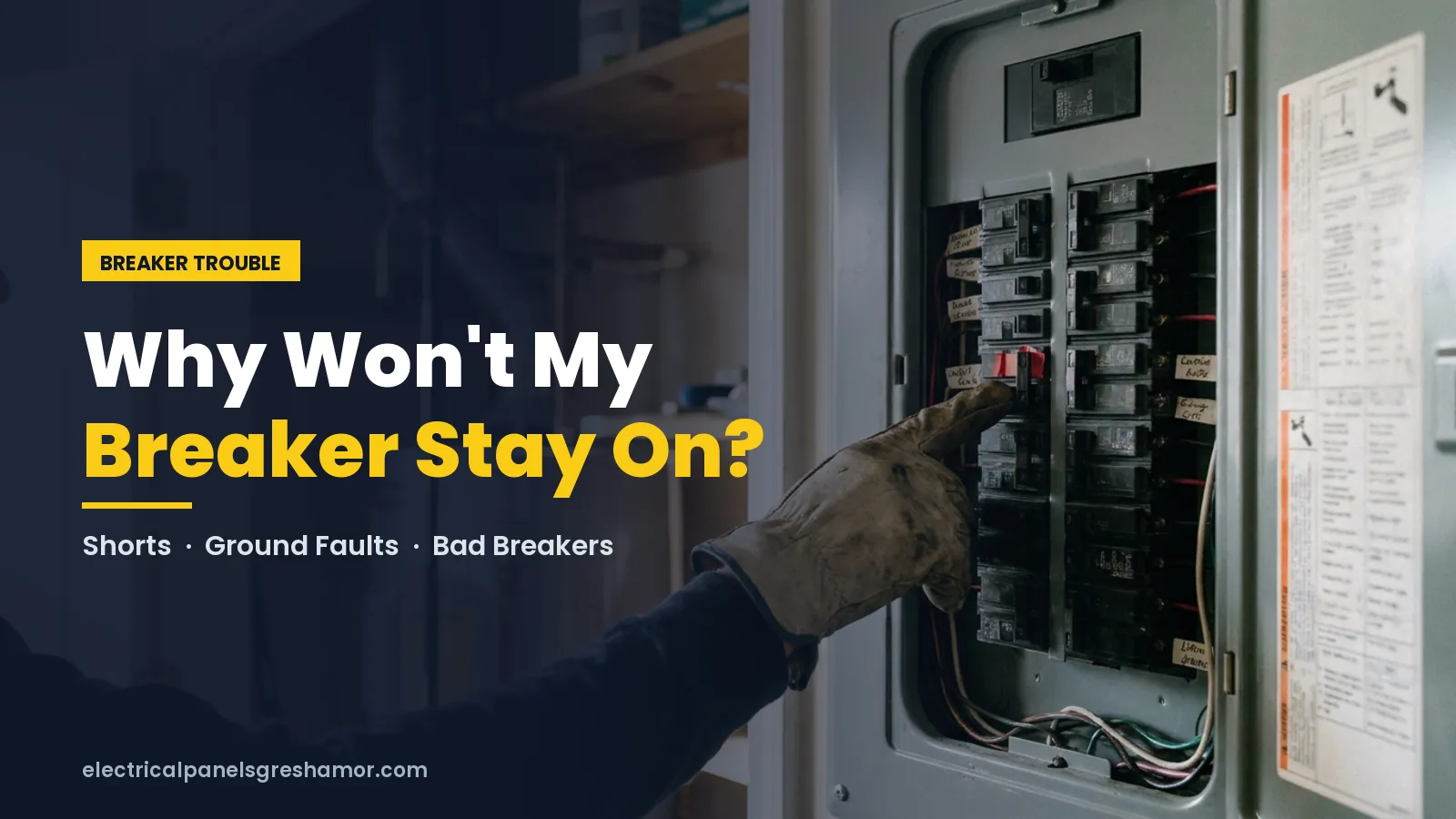
You flip the breaker back on and it snaps right off again. Or it will not click into place at all. The handle just flops in the middle. It is frustrating, and it can feel like the panel is broken.
Usually the breaker is doing its job. It is refusing to send power into a problem. The trick is to figure out which problem, and that starts with how you reset it.
Are You Resetting the Breaker the Right Way?
A tripped breaker sits in the middle. Push it firmly all the way to OFF until it clicks, then push it to ON. Skipping the OFF step is the most common reason it will not stay on.
When a breaker trips, its internal latch releases. Pushing to OFF resets that latch. Only then can the handle lock in the ON position. Some brands need a firm push. If it springs back from ON right away, move on to the causes below.
What Are the 6 Main Causes?
| Cause | Typical sign |
|---|---|
| 1. Short circuit | Instant trip, sometimes a pop or scorch mark |
| 2. Ground fault | Instant trip, often wet areas or outdoors |
| 3. Overload | Stays on a few minutes, then trips |
| 4. Faulty appliance | Trips only when one device is plugged in |
| 5. Bad breaker | Will not latch even with nothing connected |
| 6. Arc fault | AFCI breaker trips, often on damaged cords or wires |
Shorts happen when a hot wire touches a neutral or another hot. A nail through a wire, a crushed cord or a failed appliance can do it. Ground faults happen when a hot wire touches ground, a metal box or water. In Oregon, outdoor outlets and buried wire after heavy rain are common sources. See why a breaker trips when it rains.
What Does the Timing of the Trip Tell You?
Instant trips point to shorts and ground faults. Delayed trips point to overloads. No latch at all points to the breaker.
Why Do AFCI and GFCI Breakers Trip More?
They watch for more than overloads. GFCI breakers trip on tiny current leaks to ground. AFCI breakers trip on arcing patterns. Both can trip with no overload at all.
Many have a test button and a trip indicator. Some show a code with a small LED after a trip. Check the breaker label or the maker's site to read it. An AFCI that trips when one vacuum runs may be catching a damaged cord. A GFCI that trips in wet weather is often catching a damp outdoor outlet.
Shared neutrals cause trouble too. If two circuits share a neutral and one is on an AFCI or GFCI, it may never stay on. That needs an electrician to fix the wiring.
How Do You Troubleshoot a Breaker That Won't Stay On?
Unplug Everything
Every device on that circuit. Switch off lights it feeds.
Reset Properly
Firmly OFF, then ON. Does it hold now?
Add Loads Back
One at a time. The one that trips it is the suspect.
Still Trips Empty?
Stop. The fault is in the wiring or breaker. Call an electrician.
If the breaker holds with everything unplugged and trips when one device goes back in, that device is faulty. Replace or repair it. If it trips with nothing connected, read why a breaker trips with nothing plugged in.
When Should You Call an Electrician?
- The breaker trips with nothing connected
- You hear a pop or see scorch marks
- The breaker is hot, or the panel smells of burning
- The handle feels loose or will not latch at all
- Several breakers trip at once
Never hold a breaker in the ON position, tape it or swap it for a larger size. The breaker is protecting the wire inside your walls. Replacing a failed breaker is quick and inexpensive for an electrician. If the panel itself is old or a known problem brand, see should a 50 year old electrical panel be replaced.
Does the Breaker Type Change What You Check?
Yes. Standard, GFCI, AFCI and dual function breakers trip for different reasons, so the first check depends on which one you have.
| Breaker type | How to spot it | Trips on |
|---|---|---|
| Standard | Plain handle, no test button | Overloads and shorts |
| GFCI | Test button, white pigtail wire | Current leaking to ground |
| AFCI | Test button, often labeled AFCI | Arcing patterns, plus shorts |
| Dual function | Labeled CAFCI/GFCI or DF | Both arcs and ground leaks |
If a standard breaker will not stay on, look for a short or a failed breaker. If a GFCI breaker will not stay on, think water, damaged cords and outdoor wiring. If an AFCI will not stay on, think damaged cables, loose connections and shared neutrals. Newer AFCI and dual function breakers often show a trip reason with a light pattern after you reset them. The code chart is usually printed on the breaker or in the maker's online guide.
Newer homes in Gresham have many AFCI circuits, since the code expanded them to most living areas. That makes this check more useful than ever.
One last tip. Before calling, write down which breaker it is, what was running when it tripped, and whether it trips instantly or after a delay. Take a photo of the panel label and the breaker itself. These details let an electrician arrive with the right parts and often cut the visit time in half, which saves you money.
FAQ
Can a breaker go bad without tripping?
Yes. A breaker can fail to latch, or worse, fail to trip. Old breakers and some older brands are more prone to this.
How do I know if a breaker is bad?
If it will not latch with nothing connected, feels hot, or is visibly damaged, it is likely bad. An electrician can test it.
Is it safe to keep resetting a breaker?
Once or twice to troubleshoot is fine. Repeated resets on a short can damage wiring and the breaker.
Why does my breaker trip when I flip a light switch?
Often a short in the fixture or switch box. Leave the switch off and have the fixture checked.
Can a breaker trip because of the weather?
Yes. Rain can cause ground faults in outdoor outlets and wiring, tripping GFCI breakers.