

Does a Subpanel Need Separate Neutral and Ground Bars? The Rule Explained
Does a subpanel need separate neutral and ground bars? Yes. In every subpanel the neutral conductors must land on an isolated neutral bar, and the equipment grounds must land on a separate ground bar bonded to the metal enclosure. The two only connect at the main service. Mixing them in a subpanel puts normal neutral current on ground wires, metal boxes and pipes, which creates shock risk and can stop breakers from clearing faults properly.
Key Takeaways
- Neutral and ground are bonded only at the main service.
- Subpanel neutrals go on an isolated bar.
- Subpanel grounds go on a bar bonded to the box.
- Remove the bonding screw or strap in the subpanel.
- Feed the subpanel with four wires.
- Mixed bars are a top inspection failure.
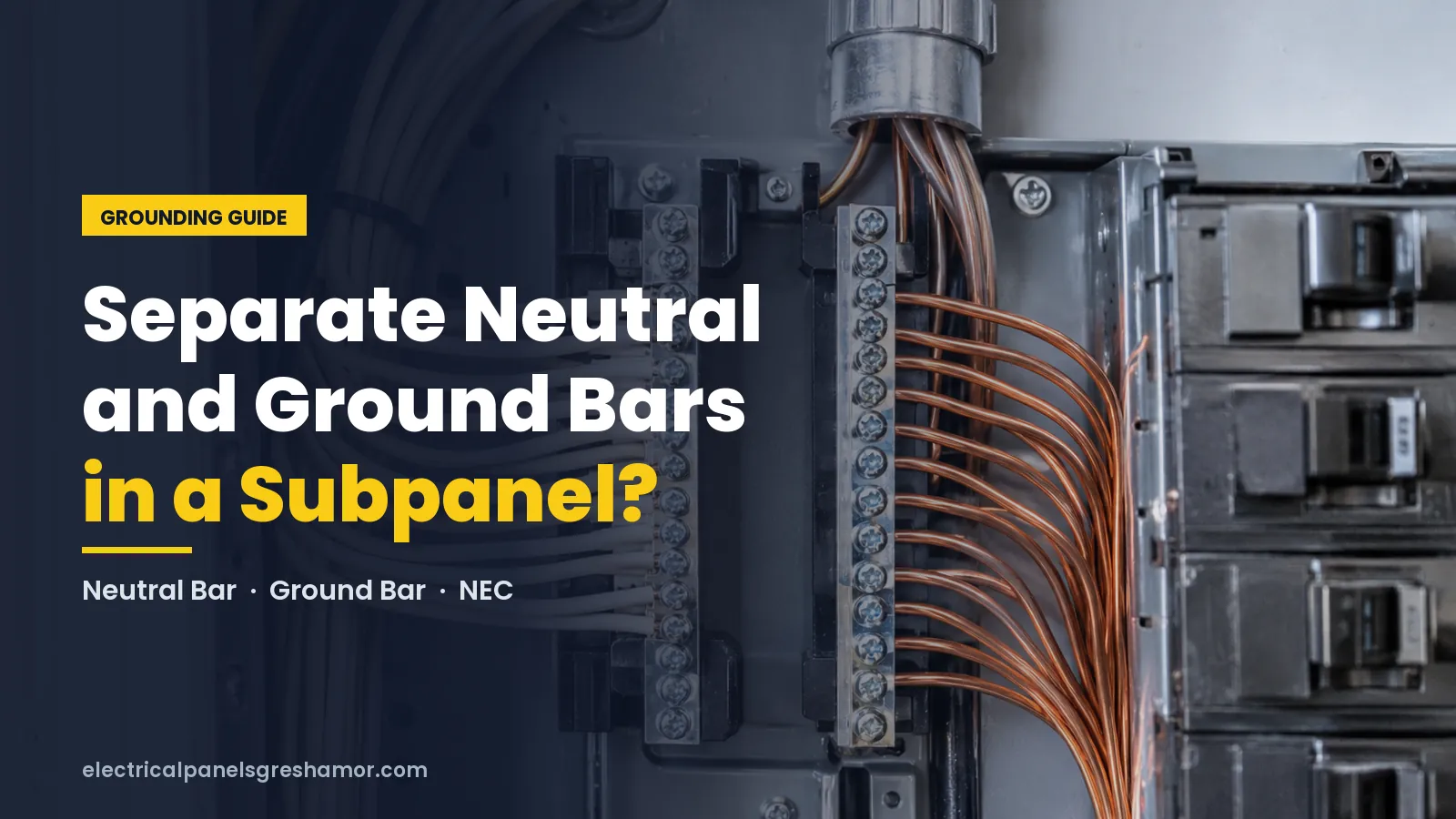
Open a main panel and you will often see white neutrals and bare grounds on the same bar. Open a subpanel and do the same thing, and you have a code violation. It looks identical, which is why so many DIY subpanels get it wrong.
The difference comes down to one idea. Neutral and ground must meet at exactly one place in the system. That place is the main service. Everywhere downstream, they stay apart.
Do Neutrals and Grounds Have to Be Separated in a Subpanel?
Yes. NEC 250.24(A)(5) and 250.142(B) prohibit connecting neutral and ground on the load side of the service disconnect, with narrow exceptions.
The neutral bar in a subpanel must be isolated from the enclosure. That is why most panels ship with the neutral bar on insulators and a bonding screw or strap you can remove. The ground bar is bolted to the metal can, so all grounds and the box share one path back to the main panel.
What Is the Difference Between Neutral and Ground?
| Neutral (white) | Ground (bare or green) | |
|---|---|---|
| Job | Carries normal return current | Carries current only during a fault |
| Current in normal use | Yes, often several amps | None |
| Connects to | Isolated neutral bar | Ground bar and metal enclosure |
| Bonded together | Only at the main service | |
Think of the neutral as a working wire. It carries current back to the utility transformer every time a light is on. The ground is a safety wire. It sits idle until a hot wire touches metal. Then it gives fault current a low resistance path, so the breaker trips fast.
Why Does It Matter If They Are on the Same Bar?
If they are joined in a subpanel, normal neutral current splits onto the ground wire, the feeder ground, the box and any connected metal.
- Metal boxes, conduit and appliance frames can carry current
- Touching metal and a separate ground can give a shock
- GFCI and AFCI devices can nuisance trip
- Fault current paths become unpredictable
- Neutral current on water pipes or gas lines can corrode them
If the neutral feeder ever loosens, the problem gets worse. All return current then flows on the ground path. That is how people get shocked touching a washer or a metal sink. The separation is not paperwork. It keeps current where it belongs.
What Does the NEC Say?
| Section | Requirement |
|---|---|
| 250.24(A)(5) | No neutral to ground connection on the load side of the service disconnect |
| 250.142(B) | Neutral not used to ground equipment downstream of the service |
| 408.40 | Panelboard grounds terminated on a bar bonded to the enclosure |
| 250.32(B) | Detached buildings need an equipment ground with the feeder |
The 2008 NEC ended the old three wire feeder allowance for new detached buildings. Today, even a garage subpanel 100 feet from the house gets four wires and separate bars. See does a subpanel require 4 wires.
How Do You Wire the Bars Correctly?
Remove the Bond
Take out the green screw or strap so the neutral bar is isolated.
Install a Ground Bar
Use the listed accessory bar, bolted to the enclosure.
Land the Feeder
Feeder neutral to the neutral bar. Feeder ground to the ground bar.
Sort Branch Wires
Every white to neutral. Every bare or green to ground. Never mixed.
Most subpanels ship with only a neutral bar. The ground bar kit is sold separately. Using the main breaker panel as a subpanel follows the same steps. See can you use a main breaker panel as a subpanel. And for the bonding screw itself, read does a subpanel need a bonding screw.
What Are the Most Common Mistakes?
"Ground and neutral go to the same place anyway."
Only at the service. Downstream they must stay apart.
"I can leave the green screw, it is just extra grounding."
It bonds the neutral to the box and creates parallel paths.
"A three wire feeder is fine for an outbuilding."
Not for new work. Four wires are required.
Another slip is putting grounds on the neutral bar because the ground bar is full. Add a second listed ground bar instead. And neutrals must have one wire per terminal on most bars, under 408.41.
How Can You Tell If Your Subpanel Is Wired Wrong?
Signs include a bonding screw still in place, grounds on the neutral bar, or only three wires in the feeder. An electrician can confirm safely.
Many homeowners first learn about this during a home inspection. The inspector removes the cover and sees white and bare wires sharing a bar in a garage or basement subpanel. It is one of the most common findings on houses with DIY additions or older shop panels.
- Green bonding screw or strap still installed in the subpanel
- Bare copper grounds landed on the same bar as white neutrals
- No separate ground bar in the enclosure at all
- A three wire feeder with no equipment ground
- Mild shocks from metal appliances or fixtures on that panel
Fixing it usually means adding a ground bar, moving the grounds, and removing the bond. If the feeder has only three wires, a new four wire feeder may be needed, which costs more. An electrician can also measure current on the ground wire. Any steady current there points to a bond or a neutral connected to ground somewhere it should not be.
Correcting this is far cheaper than dealing with a shock or a fire, and it clears a common item from home sale repair lists.
FAQ
Can grounds and neutrals share a bar in a subpanel?
No. They must be on separate bars, with the neutral bar isolated.
Why are they together in my main panel?
The main service is the one place where neutral and ground are bonded.
Can two neutrals share one hole on the bar?
Usually not. NEC 408.41 requires one neutral per terminal in most panels.
Can grounds share terminals?
Often yes, if the bar is listed for it. Check the panel label.
Does a detached garage subpanel need separate bars?
Yes, plus a local grounding electrode.