

Why Does a Circuit Breaker Trip After 10 Minutes? Overload Explained
Why does a circuit breaker trip after 10 minutes? Almost always because the circuit is overloaded. Breakers have a heat sensing part that trips slowly when current runs a bit too high for too long. A space heater, a window AC or two big appliances on one circuit can run fine at first, then trip minutes later. Less often, a loose connection or a worn breaker is to blame.
Key Takeaways
- A delayed trip is a thermal trip. It means too much current for too long.
- The bigger the overload, the faster the trip.
- Space heaters, AC units and hair dryers are the usual culprits.
- A hot breaker or loose wire can cause trips at normal loads.
- Never swap in a bigger breaker. The wire is what it protects.
- The fix is less load, a new circuit or a breaker replacement.
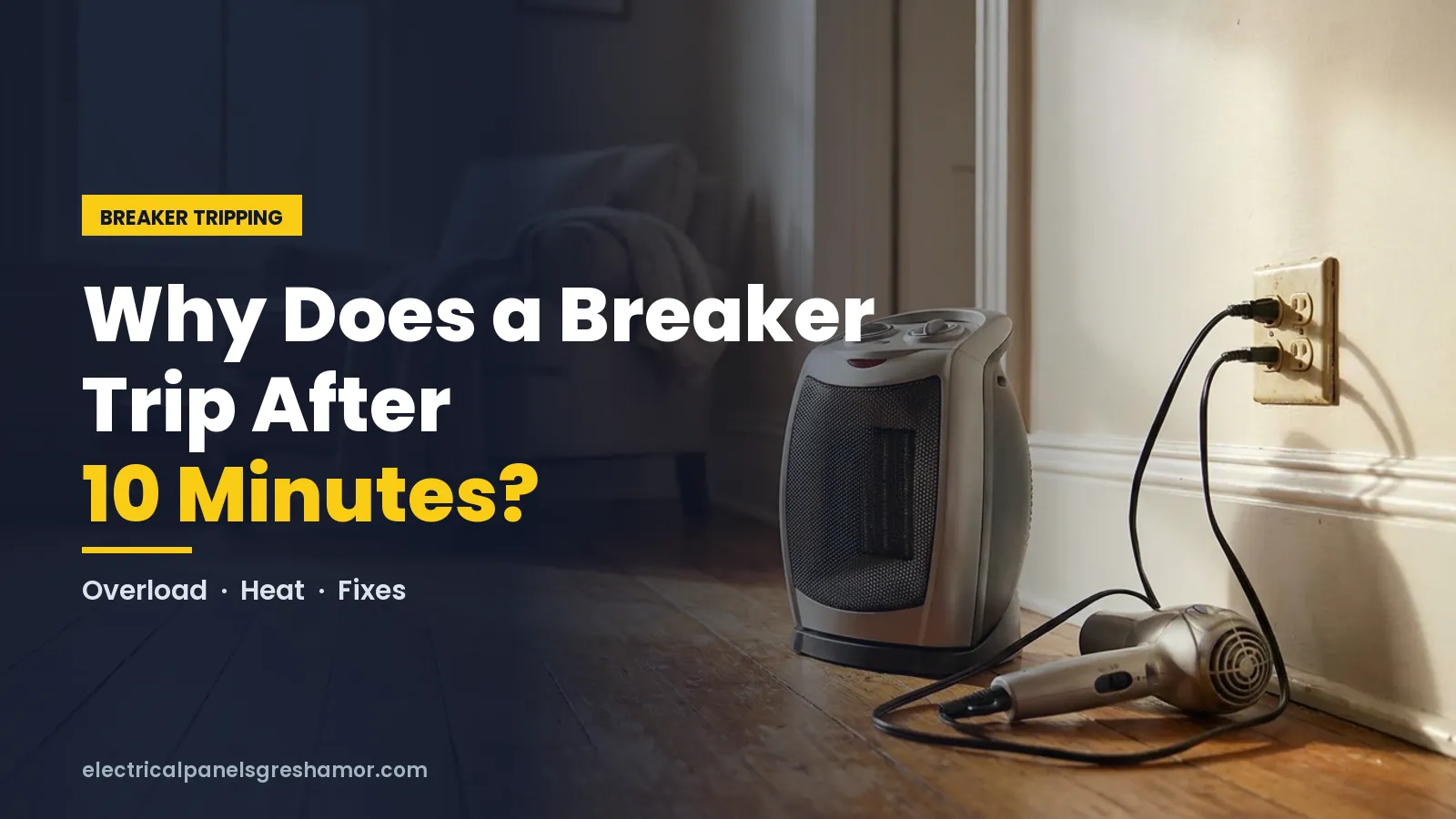
You turn on the space heater. The room warms up. Ten minutes later, everything goes dark. You reset the breaker, and the same thing happens again.
That delay is the clue. A breaker that trips instantly is reacting to a short. A breaker that waits is reacting to heat. It is telling you the circuit has been working too hard for too long.
Why Does a Breaker Wait Before Tripping?
Breakers have two trip parts. A magnetic part trips instantly on a short. A thermal part trips slowly on overload, as a metal strip heats and bends.
The thermal part is a bimetal strip. Two metals bonded together expand at different rates. As current flows, the strip warms. If current is only a little high, it warms slowly. After several minutes it bends far enough to release the latch. Click. The breaker trips.
This delay is on purpose. Motors and compressors pull a big rush of current when they start. If breakers tripped on every short spike, your fridge would kill the power daily. The delay lets short surges pass but stops long overloads that heat the wires.
How Fast Does a Breaker Trip on Overload?
It depends on how far over the rating you are. A small overload can take many minutes. A large one trips in seconds.
UL 489, the standard for molded case breakers, sets the outer limits. A breaker must hold its rated current indefinitely. At moderate overloads it must trip within a set time, often within an hour. At twice its rating, small breakers trip in roughly a couple of minutes or less. A trip after 10 minutes usually means you are only a bit over the limit.
What Usually Overloads the Circuit?
| Appliance | Typical current at 120V |
|---|---|
| Space heater, high | 12 to 12.5 A |
| Hair dryer | 10 to 15 A |
| Window AC unit | 5 to 12 A |
| Microwave | 8 to 13 A |
| Vacuum cleaner | 6 to 12 A |
| Gaming PC and monitors | 3 to 6 A |
Add two of these on one 15 amp circuit and you are over the limit. A space heater plus a hair dryer in a bathroom. A heater plus a vacuum in a bedroom. A window AC plus a gaming PC. Each one alone is fine. Together they slowly heat the breaker.
Gresham winters make this common. Space heaters come out in November. Many older homes have bedrooms on one 15 amp circuit with several rooms sharing it.
Can the Breaker Itself Be the Problem?
Yes. A worn breaker, a loose wire on its terminal or poor contact with the bus can heat the breaker. It then trips at normal loads.
- The breaker feels hot to the touch
- Trips happen even with light loads
- Burn marks or discoloration near the breaker
- Buzzing or a burning smell from the panel
Heat from a bad connection adds to heat from current. The bimetal strip cannot tell the difference. So a breaker with a loose screw trips early. That is a fire risk, not just a nuisance. Turn the circuit off and call an electrician. If the panel also hums, read why an electrical panel makes a buzzing noise.
How Do You Find What Is Causing It?
Map the Circuit
Turn the breaker off. Note every outlet and light that goes dead.
List the Loads
Write down what is plugged into those outlets and their wattage.
Remove the Big One
Move the heater or AC to another circuit. See if trips stop.
Feel for Heat
If trips continue on light loads, a warm breaker points to a fault.
Most cases end at step 3. The heater was sharing a circuit with something else. If the trips continue with almost nothing on the circuit, the problem is in the wiring or the breaker. Our guide on a breaker that trips with nothing plugged in covers that.
How Do You Stop a Breaker From Tripping After 10 Minutes?
"Just put in a 20 amp breaker."
If the wire is 14 gauge, a 20 amp breaker lets it overheat. That is how fires start.
"Use a heavy extension cord to another room."
A cord adds a weak point and often still lands on the same circuit.
"Tape the breaker on."
Never. The breaker is the only thing stopping the wire from overheating.
Real fixes are simple. Spread the loads across circuits. Use a lower heater setting. Add a dedicated circuit for a heater, AC or office. Replace a breaker that runs hot. If the panel is full or old, a subpanel or upgrade may be needed. See should a 50 year old electrical panel be replaced.
Do Older Gresham Homes Trip More Often?
Often, yes. Homes built before the 1980s were wired for far fewer appliances, with many rooms sharing one circuit.
A 1960s ranch house might have three bedrooms and a hallway on a single 15 amp circuit. That was plenty for lamps and a radio. It is not enough for a space heater, a gaming setup and phone chargers running at once. Kitchens in older homes may have only one or two counter circuits, while modern code calls for at least two 20 amp small appliance circuits.
Older breakers also wear. A breaker that has tripped hundreds of times over decades can become weaker and trip sooner. Some older panel brands have a reputation for breakers that do not trip reliably at all, which is the opposite and more dangerous problem.
- Map circuits so you know which rooms share a breaker
- Label the panel door clearly after mapping
- Add dedicated circuits for heaters, AC units and home offices
- Ask about a panel check if breakers are original to the house
If the panel has no open spaces for new circuits, a subpanel can add room. See is there a limit to how many subpanels you can have.
FAQ
Why does my breaker trip after 10 minutes of running the AC?
The AC plus other loads on that circuit are slightly over the breaker rating. A dedicated circuit usually fixes it.
Is a delayed breaker trip dangerous?
The trip itself is the breaker working. The danger is ignoring it, or a hot breaker that trips at normal loads.
Can a breaker get weak over time?
Yes. Repeated trips and heat can wear a breaker so it trips early. Replacement is inexpensive.
How long should a breaker take to trip on overload?
From minutes to an hour for slight overloads, and seconds for large ones. It depends on how far over the rating you are.
Should I replace a breaker that trips often?
Only after checking the load. Most frequent trips are overloads, not bad breakers.