

Are Eaton BR and BRH Breakers Interchangeable?
Are Eaton BR and BRH breakers interchangeable? Yes, in the panels that accept BR breakers. BRH breakers are the same 1 inch type BR form factor, with the same clip and fit, but with a higher interrupting rating: 22,000 amps (22 kAIC) compared with 10,000 amps for standard BR. You can always put a BRH where a BR goes. You can only put a BR where a BRH was if the available fault current at that panel is 10 kA or less, which covers most homes but not every one.
Key Takeaways
- BR and BRH share the same size, clip and panel fit.
- BR is rated 10 kAIC, BRH is rated 22 kAIC.
- BRH can replace BR anywhere BR is allowed.
- BR can replace BRH only if fault current allows.
- Most single family homes are under 10 kA, but not all.
- Check the panel label and the series rating if one exists.
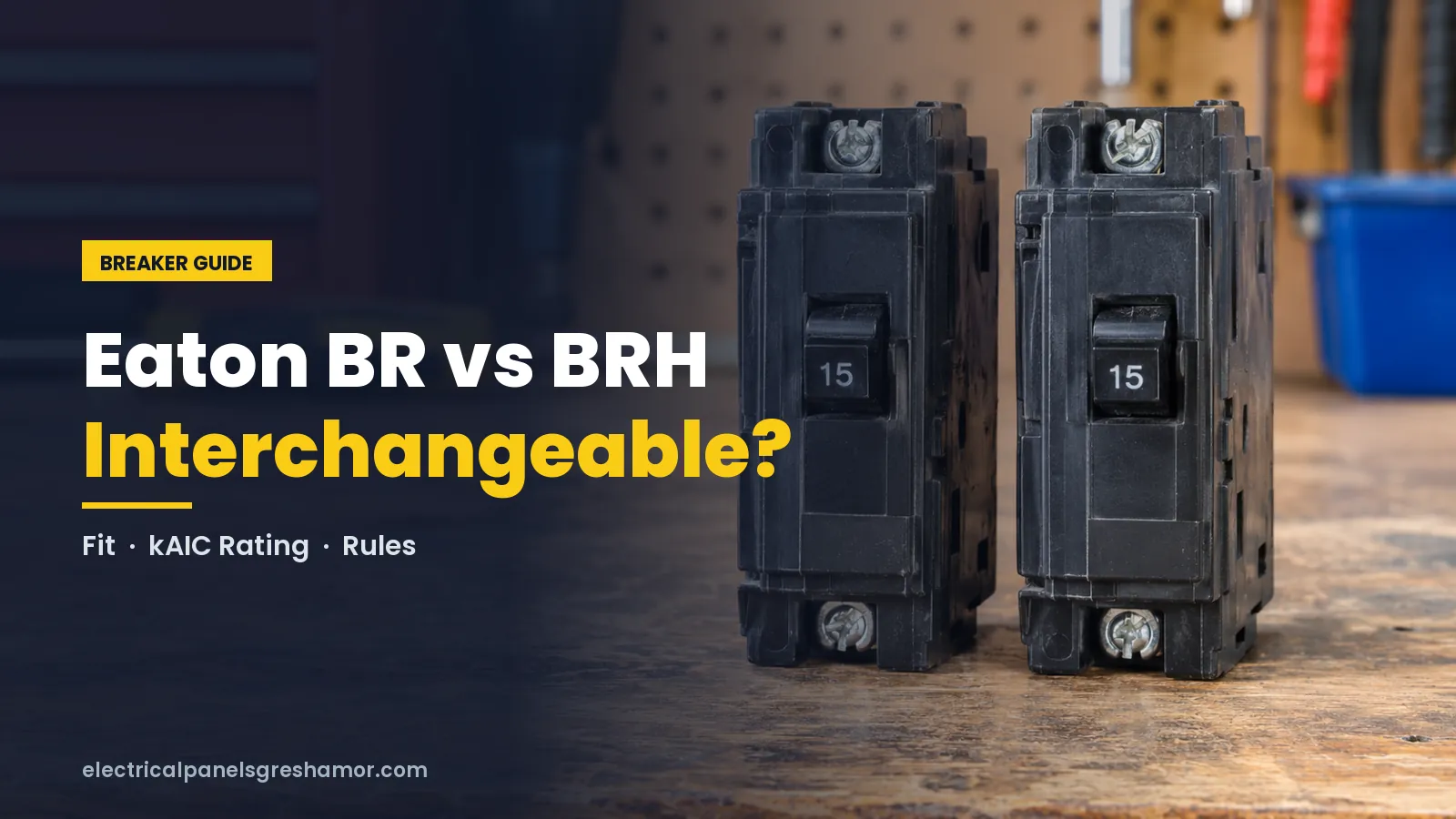
Shopping for Eaton breakers, you will see BR and BRH on the shelf side by side. They look nearly identical, and the BRH costs more. The difference is not size or fit. It is how much fault current the breaker can safely interrupt.
For most homes the extra rating is not needed. For some, it is required.
What Is the Difference Between BR and BRH?
| BR | BRH | |
|---|---|---|
| Width | 1 inch | 1 inch |
| Fits BR panels | Yes | Yes |
| Interrupting rating | 10 kA | 22 kA |
| Price | Lower | Higher |
| Typical use | Most homes | High fault current locations |
Both are thermal magnetic breakers that trip at the same amp rating on overload. A 20 amp BR and a 20 amp BRH protect the same wire the same way in normal use. The only difference shows up during a very large short circuit.
What Does the Interrupting Rating Mean?
It is the largest short circuit current a breaker can safely stop without failing. NEC 110.9 requires it to be at least the fault current available at that point.
If a breaker is asked to stop more current than its rating, it can fail violently, welding shut or rupturing. That is why the rating matters even though it never shows up in day to day use.
When Can You Swap Them?
| Swap | OK? |
|---|---|
| BRH in place of BR | Yes, always, in a BR panel |
| BR in place of BRH | Only if available fault current is 10 kA or less, or a series rating covers it |
| Mix BR and BRH in one panel | Yes, if each meets the fault current at that panel |
If the original installer used BRH breakers, there may have been a reason, such as a large utility transformer close to the house. Do not downgrade without checking. If the panel is full of BR breakers and you are adding one, BR is usually fine.
How Much Fault Current Does a Home Have?
Most single family homes with typical services see well under 10 kA at the panel, but homes very close to large pad mount transformers, or with large services and short service conductors, can exceed it.
The utility can provide the available fault current at the transformer. An electrician can calculate it at the panel, accounting for service conductor length. NEC 110.24 requires available fault current to be marked on service equipment in other than dwelling units, and many electricians note it on residential work too. Townhouses and condos with shared large transformers deserve a closer look.
What Are Series Ratings?
Some panels are tested with a main breaker that helps limit fault current, allowing branch breakers with a lower rating to be used in a combination with a higher rating.
The panel label shows a short circuit current rating, such as 22,000 amps with BR breakers when used with a specific main. If your panel carries that series rating, BR breakers may be fine even at higher fault levels. Read the label carefully, or ask an electrician. For more on BR panels, see does an Eaton BR breaker fit every Eaton panel and Eaton BR vs CH.
What Should You Buy?
- Match what is already in the panel unless you know the fault current
- Buy BRH if the panel label or existing breakers call for it
- For AFCI or GFCI, use the BR type listed for your panel
- Check amp rating, pole count and whether it is plug on neutral
- Keep receipts and packaging for warranty claims
Do not use another brand's 1 inch breaker just because it looks the same. See can you use a Square D breaker in an Eaton panel and a Siemens breaker in an Eaton panel. If a BR breaker keeps tripping, see why an Eaton breaker keeps tripping.
Most homeowners will never need to think about interrupting ratings. But when a panel already has BRH breakers, it is a good sign someone did the math, and it is worth keeping that protection in place.
Are There BRH Versions of AFCI Breakers?
AFCI and GFCI breakers in the BR line carry their own ratings, listed on each breaker. Check the label rather than assuming.
When a panel requires a higher interrupting rating, every breaker installed in it must meet that rating or be covered by a series rating. That includes AFCI and dual function breakers. Read the breaker label or the Eaton catalog for the exact rating.
How Do You Tell a BR From a BRH?
Read the printed type on the breaker. BRH breakers carry BRH in the catalog number and list a 22,000 amp interrupting rating on the label.
From the front they look almost the same, so do not go by appearance. A typical catalog number is BR120 for a 20 amp single pole BR, and BRH120 for the high interrupting version. Two pole versions follow the same pattern, such as BR230 and BRH230. If the panel has a mix, note which circuits use BRH before you replace anything. Matching the existing type is the safest choice when you do not know the available fault current. When in doubt, buy the BRH. It costs more, but it is never the wrong rating for a BR panel.
Keep the packaging for any breaker you install. It lists the ratings and listing details an inspector may ask about, and it helps if you ever need a warranty claim.
FAQ
Can I use a BRH breaker in a BR panel?
Yes. BRH is designed for BR panels.
Is BRH better than BR?
It has a higher interrupting rating. In normal use they work the same.
Can I replace BRH with BR?
Only if fault current at the panel is 10 kA or less, or a series rating covers it.
What does the H mean?
High interrupting capacity, 22 kA.
Do I need BRH in my house?
Most homes do not, but some near large transformers do.